Pages


Tuesday, July 27, 2010

SWIMMING WITH STINGRAYS


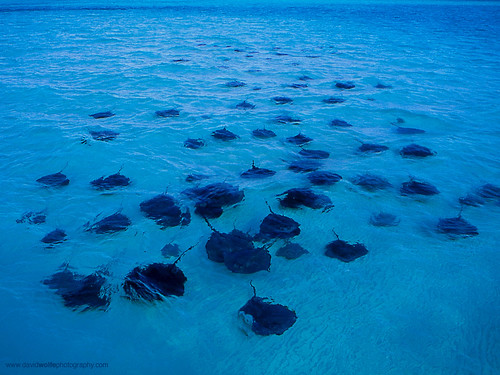
A couple of summers ago, I visited my Aunt Helen in Jacksonville, FL. My adult daughter, Holly, and daughter-in-law, Nicole, along with her baby, Kaden, accompanied me and we had a great vacation eating seafood, exploring St. Augustine, and going to the beach. Until the stingray invasion.

Holly, Nicole, and I waded out into the cool, refreshing ocean. Kaden sported a fancy inner tube. We went about waist deep, backing into the waves and laughing as the spray flew around us. Kaden enjoyed the ride in his tube. The sun was shining; the afternoon was just perfect.

"Oh, look," Holly said, pointing to a little stingray.


"Hm," I replied looking into the water. Interesting. We peered at the stingray for a moment as we moved to the side, avoiding being anywhere near it.

Before our next breath, we were surrounded by stingrays! Coming from behind, a huge flotilla bore down on us, surrounding us and cutting off our escape route to the beach. We looked around us and saw - truly - thousands of the things, a huge . . .school? . . . flock?. . . flapping from deep water to the shallow surf, flowing from our left to our right and on and on until they were out of sight!

Holly and Nicole began screaming! "EEEEEEEEEE!"

"Don't scare the baby," I yelled. "Don't scream, you're scaring the baby!"

I pulled Kaden and his tube out of the water, afraid that he might get stung.


I admit that Steve Irwin's stingray-induced death popped into my mind. "Horror!"

"No, no," I said to myself. "That was a fluke and a huge stingray. Nothing to be afraid of."

"Steve Irwin!"

"No, really, I don't need to be afraid."

"Poor Steve Irwin!" my mind debated like opposing politicians, fright and common sense fighting for my emotions.

"EEEEEEEEE!" the girls continued to scream. Both Nicole and Holly began climbing my back! "EEEEEEEEE!"

Now I'm staggering along dragging Kaden and mostly carrying Holly and Nicole, still yelling, "Don't scream. You're scaring the baby!"

We floundered toward shore, screaming bloody murder, Kaden having joined the chorus. The stingrays bumped into Holly's and Nicole's legs, accompanied by ever shriller screeches. One caught on Holly's calf, wrapped its "wings" around her leg, then wiggled itself free and swam away. "EEEEEEE!" Holly shrieked, wrapping her arms around my neck.

"You're choking me!" I squeaked. Holly released my throat and began pushing me forward.

"Shuffle your feet," Holly called, "shuffle your feet!"

"Shut up, Holly!" Nicole retorted between screams while still trying to climb my back. "Just shut up!"

At that, I began laughing, stumbling, gasping, tottering with two girls on my back and a baby in my arms, the laughter sucking the last strength from my legs.


By the time we tumbled onto the beach and sprawled on the sand, we were all shrieking with laughter and relief, except for Kaden, who howled with terror. Wiping the stinging salt water from my eyes, I looked around at the other vacationers. Not one person had noticed our distress or the stingray armada currently cruising beyond our sight.

We didn't go back onto the water that day.

Tuesday, July 6, 2010

RUN WITH YOUR MOUTH CLOSED!


A few years ago, I was running along the highway in the hot summer with my mouth open and my tongue dragging along the street behind me when a bumble bee flew into my mouth!

Not missing a step, I puckered up and blew the bee out, desperately trying to keep my tongue and lips away from its stinger.

"Fwoof." Out it came without hurting me at all. But I realized that I had lightly touched it with my tongue, because the yellow and black "visitor" felt fuzzy and tasted sweet.

Wednesday, June 2, 2010

INJURED LOON VISITS COCHRAN MILL NATURE CENTER


We had an interesting visitor at the center this week. A loon, apparently on its way north. Here is what Rick, who cares for all of the center's animals, had to say:

The loon was brought in from the Atlanta airport by the Aviation Authority. It had landed on a runway. Apparently this happens sometimes where the loon mistakes the runway for water. They can only take off from water and need about a football field's length to run across as they take off.

It had some abrasions to its feet and wings, so we put some topical antibiotics on.

Two rehabbers on the coast gave me some very important information regarding this species. Because their legs are so far back on their bodies, they have to lie in a donut-shaped towel if they're in a carrier or they will quickly get sores on their keel as they can't hold it up. Also, they will lose the waterproofing of their feathers if they don't have constant clean, refreshed water, so the kiddie pool was not a good solution long term.

It didn't eat any of the fish I tried (as far as I can tell). I took it to a private lake today and released it and it appeared very happy to be free.

I was totally taken aback at how aggressive (defensively) it was! It would go out of its way to come after you if you pressed its space. Worse bird I've dealt with in that respect. Worse than any raptors! Whod've thunk it??

What a beautiful haunting cry they have. They are also very beautifully colored and marked when in their breeding plumage.The injured loon was either young or not in its breeding plumage.

There are many loon fans who go to the northern states in order to see/hear them in the wild. I have a friend who lies in the Adirondacks in loon country and he was talking to some loon revelers once and he told them, "I shoot them and eat them!" They were horrified and one asked, "What do they taste like?" He replied casually, "They taste like Bald Eagles!"

I'm glad to know that Rick released the loon. Its sad call, repeated often, seemed to be searching for its flock or at least another of its kind. I hope that it has joined other loons and is winging its way north.


LOONY FACTS:

Starting with the name: The bird's name MIGHT have come from its eerie yodel, especially when heard on moonlit nights. Some of its calls resemble crazy laughter, hence "loon" as we think of strange persons. And the word "lunatic" originally referred to a person who became deranged by sleeping in moonlight (luna = moon). Maybe families huddled in their safe, tightly closed cottages heard weird cries in the night and imagined lost souls wandering around a lake howling and laughing.

Common Loons dive and fish underwater, catching their prey and swallowing it, aided by backward-facing sharp knobs in their mouths that prevent escape of the intended dinner. They can stay under water for almost five minutes while fishing.

The Common Loon is Minnesota's state bird.

You might hear one of four calls from the loon: the tremolo, like maniacal laughter, is an aggressive one; the wail, a lonely-sounding long call; the hoot, used to communicate among parents and offspring; and the yodel, made by males defining their territory.

In the summer, loons are speckled black and white with a blackish, iridescent-green head. Their bills are black and their eyes are red. The red eye helps the loon see underwater. Winter colors are gray and white, like the loon which visited CMNC.

Both parents sit on the nest and care for their one or two babies. The young can leave the nest after just a day, but can't fly for two months. The parents often carry their offspring on their back to protect them from predatory fish and turtles in the water.

Their menu includes fish, frogs, leeches, crayfish, mollusks, salamanders and insects.

Young loons are on the menu of skunks, raccoons, foxes, snapping turtles, northern pike and muskies. Only the bald eagle is likely to eat the adults.

Loons have solid bones, unlike most birds whose bones are hollow. The extra weight helps them dive for food but, because their bodies are heavy relative to wing size, they need a 100 - 600-foot "runway" to take off from a lake. Once up, they can fly faster than 75 miles per hour.

Loons may live for more than 30 years.

Sunday, May 23, 2010

MAGGIE SMILES


This week, Maggie turns 6 years old. Magdalena Harbin-Simpson, as she is called when she is in trouble, is a Yorkshire terrorist, I mean terrier. She's about 6 inches tall, black and gold and beautiful.


Maggie really belongs to my daughter, Holly.
But Holly married Ben in November, so we share custody of Maggie. Holly wants Maggie to continue to enjoy being with Grandy and Pawpaw and our toy poodles, Silvie and Michelle, Queen of the World.


GIZMO (DECEASED), SILVIE, MAGGIE, AND MICHELLE


I know that almost everyone loves his or her dog. Every dog has its own personality and charm. We love our poodles as much as we love Maggie, but Maggie came to our family at a very hard time and has been a real comfort and source of happiness for her Pawpaw as he suffered through the failure of his businesses and the financial hardship that followed.


Any doggie can lift depression if its owner appreciates it But our Maggie is such a strange little girl and so friendly, loving, and funny that she helped my husband (and the rest of us) get through a "rough patch" as her fellow countrymen would say with typical British understatement.


Because Maggie smiles. And those merry smiles amuse us and distract us from our troubles. They are not just the smiling eyes and lowered ears that most dogs do to express happiness and friendliness. She actually lifts her lips and pulls them back in a real toothy smile. She's not the only dog I know of who smiles. We fostered a lab who smiled in the same way, wrinkling her nose quite delightfully. Several friends have told me that their dogs smile, too. It's a greeting, along with submission. Maggie adds sneezing and snorting to her submissive smiles.

Maggie greets EVERYONE she meets. Everyone. In the neighborhood, on a walk, in the park, any dog, person, or cat gets greeted with sneezes, snorts, smiles and her patented, tummy flaunting rollover. It's obvious when Maggie sees someone to greet. Her perky ears flatten, rise up, and flatten again, as she darts in their direction, smiling, sneezing, and snorting "Are you my friends? Can we be friends? I like you, do you like me? Let's be friends! Look! Here's my tummy! Rub my tummy! Do you love me?!!!"

It can be quite overwhelming. Most people just laugh and pet the little long-haired dust moppet. But sometimes small children and dogs are taken aback and retreat behind someone's legs to peer at this noisy whirlygig. Undeterred, Maggie gets up and approaches more slowly, rear-end first, just in case. A bite on the little hiney is not as painful as a bite on the little nosey, Maggie has learned (from Michelle, Queen of the World).


Of course, nobody can be so good all the time, even Maggie. She has a fear-hate relationship with our cat, Hobbs. Hobbs is a huge tom cat. He routinely stalks and attacks Maggie and Silvie, the smaller poodle. Michelle, Queen of the World, is VERY serious about her dignity and stature and has taught Hobbs to leave her totally alone. But Maggie is ambivalent - sometimes being scared of Hobbs and sometimes stalking him and chasing him through the house. IF he will run from her.


Sometimes Maggie skulks around and suddenly attacks Hobbs -- and he just stands there glaring "I don't THINK so!" Then Maggie veers away and finds a great need to smell the leg of a chair to cover her embarrassment. She hadn't meant to chase the cat, anyway; he was just in her path as she went to smell the compelling odor on the chair.


Maggie has other oddities, too. When she was a little puppy we lived in a two-storey home. The stairs were taller than Maggie. She learned pretty quickly to climb up the stairs, but going back down scared her. At first, she would stand at the top of the steps and cry until someone came to rescue her. Later, she took matters into her own hands - er paws. First she would stand at the top of the stairs growling menacingly to intimidate the staircase. Then Maggie would "sled" down the carpeted stairs on her tummy with her front legs in front of her and her hind legs stuck out behind, growling all the way. Apparently the steps were sufficiently bullied, as Maggie always arrived safely at the bottom.


Another unusual trait of Maggie's: From puppyhood she has naturally sat up on her haunches. We taught our poodles to "beg" in this position, but Maggie routinely pulls herself up in what we call "prairie dog" position, stands all the way up, and lowers herself back to "prairie dog" without ever touching down with her front feet. Maybe Yorkies have exceptional balance or maybe it's just Maggie.


I believe that Maggie sometimes pictures herself as a much bigger dog. When she hears her "sisters" barking outside, she trots officiously through the house on her stubby little legs, with her "nubbie" (her cropped tail) sticking straight up through her back hair, creating a "rooster tail," barking her Rottweiler bark "Roo-quough," giving every indication that she is on the way to take care of whatever needs to be straightened out. Of course, if there is a person or dog out there, she begins her smiley, snorty, sneezey routine and rolls over to display her belly.


Soon Maggie will come to stay with her Pawpaw for a few days and cheer up the whole household with her antics. We are looking forward to seeing her -- and the cat is just ecstatic.

Thursday, May 6, 2010

THE CUP COMPLEX

The following is a "girls only" post; we'll have something for you later, guys!


Breasts, boobs, boobies, knockers, ta-tas, bosom, bozooms, ninnies, lungs, chest, jugs, bazoombas, etc., etc., etc.

As Yul Brenner said in the musical play “The King and I,” “Is a puzzlement.” Why do we have so many names for this portion of female anatomy? Do men prefer large breasts? Why do we use of these same terms when speaking of idiots? Is it societal pressure that causes sensible women to “enhance” their attributes? And, most importantly, what don’t I have big ones?

Okay, why do we have so many pseudonyms for these protuberances? Dr. Jackie Boles, Professor of Sociology at Georgia State University in Atlanta said, “Generally anthropologists have found that a culture has a lot of words for things that are important and few for those that aren’t.” If this is true, these outstanding female appendages must be intensely important to our culture.


GENTLEMEN PREFER BOOBS

Now, I’m not saying all men idolize enormous breasts. Obviously not – or many of us would have remained unmarried and virginal. And it’s not just a matter of some poor guys “making do” when all the C and D cup women are taken. My own husband said, upon intense questioning, “Oversized breasts are no more sexually appealing to me than oversized earlobes.” Is he sincere? Of course. Do I believe him? Of course. He married me, didn’t he? Isn’t that uplifting for those of us with a paucity in our statistics?

Still, I observe that “built” women command attention. Be it bikini-clad beauties on the beach or stylish ladies swathed in silk, let a D-cup appear and all male eyes go “boing!” These eyes are, as my father used to say, “run out on stems.”

“The female body,” Dr. Boling explained, “is shaped to act as a stimulant to men, both coming and going. That is, large breasts and rear ends attract men.”

I have personal experience in this realm. While nursing my daughter, my cup runneth over. Many people, from my father-in-law to my nieces, complimented me. My step-sons (both breast men) teased me, “You’re going to make that poor baby nurse until she goes away to college, just so you can have a big chest, aren’t you?”

Suddenly I was a star. My public consisted totally of men. Doing ordinary errands became an adventure, not unlike wading through a muddy pen of affectionate hound dogs while dressed in white slacks. One day I drove to the drug store, got out of my car, and hoisted my heavy, sweet-smelling infant to my hip.

“WHOA!” Someone yelled. I jumped and nearly dropped my baby. “WHO-EEE! Look at that pair!” A pickup truck cruised slowly by, the two men inside grinning, shouting, and whistling as I trudged, red-faced and perspiring with embarrassment, across the parking lot. “Have you no respect for motherhood?” I muttered angrily to myself, shifting the baby around and carrying her tightly against my chest.

Then there was the time in the elevator. I went to the hospital for a checkup and X-ray. I completed my checkup on one floor and was going upstairs, in my hospital gown and jeans, for my X-ray. Several people rode the elevator with me. One was a wormy little guy who slouched, needed a shave, and smelled like last week’s garbage. Well, he clapped those bleary eyes on my unfettered, milk-swollen mammary glands, and remained mesmerized, transfixed, and totally unmoving throughout the ride. Arriving at my floor, I sailed past him, preceded by my magnificent prow, and only his neck moved to keep his eyes plastered my mighty melons.

Of course, there was occasional flirtatious eyeballing from attractive men and I basked in the realization of my childhood dream. All of this admiration, both the welcome and the unwelcome, ceased abruptly after weaning. But, for a year, I possessed the build I had looked forward to so expectantly when I was a child.

CUP COMPLEX, OR, MUST I WEAR A TRAINING BRA FOREVER?

When I was a child, during the 1950’s, buxom women were the ideal. Marilyn Monroe, Jayne Mansfield and Sophia Loren are just a few stars whose titanic “headlights” highlighted the silver screen. Boys dreamed of marrying full-figured Lovable (bra) girls when they grew up. Girls dreamed of achieving glamorous dimensions one day. I did.


Thumbing through a Sears catalog, I noticed how pretty the models looked. In plaid shirts. In frilly blouses. In evening gowns and swim suits. I yearned for the day when I, not “June” would “be bustin’ out all over.” I dreamed and waited. And waited. If only I had looked at my mother and all her sisters, I would have surely suspected the dreadful truth. Put all five of them together and you couldn’t come up with a decent pair of breasts. And I mean if you put them all together. Cross my heart (“with a Playtex Living Bra”). If women had worn Living Bras back then, theirs would have starved.

When I was nine years old, my mother fed my dreams by casually saying, “Drinking lots of cream makes you have big breasts.” One day as I ate breakfast at our chrome-and yellow Formica table, she asked, “Why did you flood your oatmeal with cream?”

“I always put lots of cream on my oatmeal,” I replied, skimming the slightly congealed top off with my spoon.

“But why do you use so much?” she persisted.

“I want to have big breasts,” I answered nonchalantly.

“You mean,” she sputtered, “that you put all that cream on your oatmeal because you think it will make you have big breasts?”

I felt the sweet hot cereal turn to ashes in my mouth. “That’s what you said!”

“Oh, ha, ha!” she shouted. She held her middle with both arms. “Ha, ha, ha!” She staggered to a yellow plastic-covered kitchen chair and collapsed into it. “I was just kidding, you nut! Ha, ha, ha!”

Well, I was devastated. As Mama laughed herself silly, I thought of the pounds of oatmeal, the gallons of cream, all for nothing.

Beneath my lashes I directed a venomous glance my mother’s way. She’s also the one who told me the hole in a doughnut is poisonous, causing me to leave a safety ring of doughnut around all those “poison” holes for years. But that’s another story.

To add to my mortification, as I grew up skinny and flat-chested, my next-door neighbor and best friend wore a 36D by the time she was 13 years old! I ask you, is that fair? I never will forget the day she started “growing”. I was eight and she was nine. As we walked home from church, she complained, “My nipples burn.”

“What’s wrong?” I asked, squinting at her. The sun beat hot on my head that summer noon, blinding me with it’s glare.

“They’re growing,” she answered. “That’s what happens when you start to develop,” she answered smugly, flicking her eyes over my concave front.

I was eaten up with envy.

“But it burns. I want to go home,” she said fretfully. Before long, she was running. I followed her breathlessly into her home, where she rummaged in the pantry. Grabbing a large can of Crisco, she scooped up some and, jerking up her blouse, rubbed it tenderly on her chest. “Oh,” she exclaimed. “That’s so cool!”

“What in the world are you doing?” I squealed. “Why don’t you use Noxema?”

“Because this feels good!” she snapped.

“That’s foolish,” I thought, but I kept my mouth shut.

Maybe it was foolish to use Crisco – still she ended up a 36D and I . . . . well, I didn’t.

IS THAT A CUT?

Speaking of foolish, booby and ninny both mean a foolish person, according to Webster’s New Collegiate Dictionary. I wondered whether women’s primary recognizable physical trait is called by these terms for unflattering reasons. I mean, is this a put-down?

“I suspect so,” said Dr. Boles. “Check the derivation of the words.”

So I did. “Ninny” could be derived from the Spanish “nino,” meaning child. “Booby” is guessed to come from “bubby, perhaps an imitation of the noise made by a sucking infant.” I checked several dictionaries. These were the best explanations I could find. They seem to give ninny and booby a legitimate, non-denigrating derivation, separate from the “foolish” meaning. But I wonder.

GUILDING THE LILY

Maybe the “foolish” labels fit, though. What haven’t we done to enhance our bustlines? Falsies (store-bought and imaginatively home-made), padded bras, underwires. Now it seems surgery is commonplace in our quest for bounteous beauty. Ah, the stories I could tell . . . . Okay, if you insist.

In the early 1960s, padded bras were stiff enough to put a crease in your blouse. At 14, I wore an A-cup padded bra with little to put into it. One autumn night I attended a dance. My boyfriend and I danced very closely to dreamy romantic music. The first song ended and we smiled as we stepped away from each other.


My smile died when I glanced down and, to my horror, the dim light revealed, instead of two points against my white cotton blouse, I had two circles! With nothing to fill the cups, they had dented inward, resembling volcanic craters.

Whipping around so my back was to my friends, I frantically pressed my arms against the bra. “Tock, Tock,” the padding popped out, cone-shaped again. I spent the evening “tock-tocking” my bra, desperately hoping no one, especially my boyfriend, noticed my affliction.

Three years later when I visited relatives in Florida, we went to the beach. I had carefully sewn my soft pink foam falsies into my bathing suit, having learned my lesson a year earlier when one escaped and floated to shore. The sun played hide-and-seek behind the racing clouds and the wind blew relentlessly.

Swimming in terribly rough seas with my male cousin and his friend, I eyed the stripes all over their torsos where jellyfish had stung them the day before. Nervous, I closely scrutinized the water about me constantly for the tell-tale pastel blobs carrying the noxious tentacles. The much bigger boys dragged their rafts out past the breakers and enjoyed thrilling rides to the beach on that stormy day. But I just couldn’t fight my way past the breakers. The boys even tried putting me on my raft and pulling me out, but the surf was too strong.

So, while they were far out, bobbing on the swells and awaiting their next ride, I paddled around by myself in waist-deep water. A huge wave knocked me over and rolled me along the sandy bottom, while the surf roared in my ears. I burst from the water like a blowing whale, coughing and blinking the burning salt water from my eyes.

There, between my upper arm and my breast floated a pastel blob! Too terrified to touch it, I screamed and splashed at the creature hysterically. Expecting the stinging tentacles to assault my legs at any moment, I whirled, crying and splashing, trying frantically to get away from that terrifying thing which stayed despite everything. Hysteria abated shortly and I realized it was not stinging me. After my tears had diluted the sea water in my eyes, I stood still, panting, and looked carefully at the blob . . . .

Yes, it was my falsie, tenaciously clinging where I had sewn it, but plopped out by my wrangle with the undertow. Mortified, I looked around hastily, plunged under the water, and deftly stuffed my stuffing back into place. No, neither my cousin nor his friend witnessed or I wouldn’t be alive now. Do you doubt embarrassment can be fatal? To a teen?

Later in my life, my husband told me of seeing a lovely girl stroll down to the water at a beach. As she waded into the surf, nylon stocking began floating from her bikini top. “What did she do?” I gasped, cringing empathetically.

“She stuffed it all back in and came out of the water,” he replied matter of factly.

I guess men just don’t understand. To be deficient is bad enough. To be caught bluffing is unendurable. Still, a woman’s gotta do what a woman’s gotta do.


THEY’RE OUT!

Then came Twiggy – a pretty, big-eyed face attached to a skeleton barely covered with skin. Even more flat-chested than I. And proud of it! Women burned their bras, and we moved into a very comfortable period. Sure, sure, politically there was world-wide upheaveal, wars, death, and destruction, etc. Who cared? We were braless! No sliding straps. No tight bands around our bodies. No digging, strangling foundations garments. With small, firm breasts, I was in style. I was happy with myself – adequate at last.

THEY’RE IN AGAIN

So finally women were “politically aware” and physically free. We learned to accept and respect ourselves for who and what we are.

But are we allowed to age and die happy? NO-O-O! Busts are back. Everywhere you look, mountainous cleavage, billowy breasts bulging from décolletage. An ad in a department store reads, “Increases your bust by a whole cup size!” Do you know what they are selling? Little satin-covered half-pads to put under your breast. A rolled up sock would work just as well! A friend complained, “You can hardly buy a bra without underwires or padding anymore.” Yes, even the plain bra, uncomfortable though it may be, has given way to torturous devices. Wires to squeeze and poke you, padding to swelter you in summer.


What next? Where did this all start? Perusal of the fashion pages blames it all on the rock star Madonna. Madonna of the outside underwear. The pointed breastwear that reminds one of the opera soprano wearing braids and armored breastplate. We’re back to the beginning, with the pinching, cutting, slipping “cheaters” that promise to make us feel adequate. Well, all I can say is, “Thanks a whole heap, Madonna!”

Wednesday, April 14, 2010

Going Batty at Cochran Mill Nature Center


Echo, a Big Brown Bat


At the Cochran Mill Nature Center, where I work on Saturdays, we have a newish exhibit -- bats. These bats are Egyptian Tomb Bats. You'd think these four girls would be vampire bats, since they are Tomb Bats, but they eat fruit. Grapes, bananas, melon, etc., they love their fruit. They might consume tiny insects on their fruit, but it's accidental. Other bats eat a wide variety of foods including insects, small mammals, small reptiles, lizards, frogs, birds, other bats, nectar/pollen, fruit, flowers, leaves, fish, blood, scorpions, and centipedes.

"Our Girls" Isis, Cleo, Pammie, and Phaedra


These bats are bigger than Georgia's bats, being about as long as my hand. Vicky Smith, bat lady extraordinaire, cares for these bats, as well as many that she keeps at her home. Some will never recover totally and Vicky keeps them, tenderly caring for them throughout their lives.

Little Juanita, a Mexican free-tail. She had to have her tail amputated after an infection and 3 fingers removed after she broke them. "See how cute the little pink end on her tail is. Unfortunately it has now healed back to the natural color," Vicky says. "She was so cute with her prissy little pink tail, it suited her personality." (Vicky is handling Juanita with bare hands because she has been vaccinated against rabies. She emphasizes that no one should handle a wild bat with bare hands!)


Sixteen different species of bats live in Georgia, according to Vicky. Most U.S. bats weigh less than an ounce (28 grams). The bats at the Nature Center weigh 110-140 grams. Sparky (see photo) weighs only 6 grams, full grown. Our largest Georgia bats weigh about 50 grams.

Mork, a Malayan Flying Fox. They are some of the largest bats in the world.


Since she handles wild bats, Vicky has to take rabies shots, similar to vaccinations that our pets receive. Our Georgia bats are rabies vectors, along with foxes, skunks, and raccoons. NEVER handle any of these wild animals. I was happy to learn that squirrels aren't much of a danger, since my toy poodle, Michelle, had a dust-up with a squirrel once. The squirrel won.


Keket, one of Vicky's original bats, unfortunately now deceased. The holes in her wings are where "punches" were made to test DNA. Usually they heal.


I clean the bat cage each week and enjoy interacting with Isis, Cleo(patra), Pammie, and Phaedra, who all hang by their feet in the front corner of their cage. When I must disturb their morning sleep, they migrate as a group across the top of the cage, fussing a little, and hang together until I'm through, then slowly move back into their favorite spot. You can tell it's their favorite by the streaks of . . . well, you know, running down the front glass. If I lean into the cage under them, sometimes somebody wets right into my hair! I swear it's on purpose. But they can be sweet, too, sniffing at my gloved hands and watching me closely as I polish the glass. They will move just far enough for me to wipe the glass behind them, never offering to bite or scratch. (I don't have to have rabies shots, since these bats are not at risk.)

Vicky gives a supplemental feeding of banana baby food to Phaedra, who was sick.


The bats have colored rings on their thumbs (which look like part of their wings) except for Phaedra, who has removed 2. Vicky identifies them by the rings. She calls them all by name, as she takes them from the cage and examines them. Pammie has the green band, Isis has the white/light purple band, and Cleo has the yellow/hotpink band.

Phaedra, Vicky says, used to sniff her hand loudly, like a little dog, and seemed to enjoy a belly rub. She wears leather gloves for handling the "girls" since they do sometimes bite or chew on her fingers. They have pretty little faces, sort of like Chihuahuas, and teeth that look similar, too.


These little fellows live with Vicky. Elvis, was injured in a bat house accident. Sparky was injured by fireworks. He is a Southwestern myotis.


One of them sometimes chews on my glove fingertip, moving slowly. I don't think she is scared or threatening me, just curious. They also peer out of the cage when I open the door and remove the mesh, but so far (thank goodness!) haven't tried to escape.

I hope you enjoy the bat facts that Vicky was kind enough to send me. I know that some people are creeped out by bats, but they eat millions of mosquitoes a year and I really enjoy them.

You can reach Vicky Smith at www.eeingeorgia.org (Please look under the organizational tab for A-Z Animals.) For a classroom demonstration with her bats at your school, her email address is batlady1964@yahoo.com
You can visit Cochran Mill Nature Center at http://www.cochranmillnaturecenter.org/index.html


Amazing Bat Trivia

*The world's smallest mammal is the bumblebee bat of Thailand, weighing less than a penny.

*Giant flying foxes that live in Indonesia have wingspans of nearly six feet.

*The common little brown bat of North America is the world's longest lived mammal for its size, with life-spans sometimes exceeding 32 years.

*Mexican free-tailed bats sometimes fly up to two miles high to feed or to catch tail-winds that carry them over long distances at speeds of more than 60 miles per hour.

*The pallid bat of western North America is immune to the stings of scorpions and even the seven-inch centipedes upon which it feeds.

*Fishing bats have echolocation so sophisticated that they can detect a minnow's fin as fine as a human hair, protruding only two millimeters above a pond's surface.

*African heart-nosed bats can hear the footsteps of a beetle walking on sand from a distance of more than six feet.

*Red bats that live in tree foliage throughout most of North America can withstand body temperatures as low as 23 degrees F. during winter hibernation.

*The Honduran white bat is snow white with a yellow nose and ears. It cuts large leaves to make "tents" that protect its small colonies from jungle rains.
*Disk-winged bats of Latin America have adhesive disks on both wings and feet that enable them to live in unfurling banana leaves (or even walk up a window pane!).

*Frog-eating bats identify edible from poisonous frogs by listening to the mating calls of male frogs. Frogs counter by hiding and using short, difficult to locate calls.

*Vampire bats adopt orphans and have been known to risk their lives to share food with less fortunate roost-mates.

*Male epauletted bats have pouches in their shoulders which contain large, showy patches of white fur that they flash during courtship to attract mates.
Important Bat Facts

Nearly 1,000 kinds of bats account for almost a quarter of all mammals.

Worldwide, bats are an important natural enemies of night-flying insects.
A single little brown bat can catch 600 mosquitoes-sized insects in just one hour.

A colony of 150 big brown bats can protect local farmers from up to 33 million or more rootworms each summer.

The 20 million Mexican free-tails from Bracken Cave, Texas eat approximately 200 tons of insects nightly. Mother Mexican free-tailed bats find and nurse their own young, even in huge colonies where many millions of babies cluster at up to 500 per square foot. They do this by smell and sounds.

Tropical bats are key elements in rain forest ecosystems which rely on them to pollinate flowers and disperse seeds for countless trees and shrubs. In the wild, important agricultural plants, such as bananas, breadfruit and mangoes, cashews, dates, and figs rely on bats for pollination and seed dispersal.

Desert ecosystems rely on nectar-feeding bats as primary pollinators of giant cacti, including the famous organ pipe and saguaro of Arizona.

Bat droppings in caves support whole ecosystems of unique organisms, including bacteria useful in detoxifying wastes, improving detergents, and producing gasohol and antibiotics.

An anticoagulant from vampire bat saliva may soon be used to treat human heart patients.

Contrary to popular misconception, bats are not blind, do not become entangled in human hair, and seldom transmit disease to other animals or humans. All mammals can contract rabies; however, even the less than a half of one percent of bats that do, normally bite only in self-defense and pose little threat to people who do not handle them.

Bats are exceptionally vulnerable to extinction, in part because they are the slowest reproducing mammals on earth for their size, most producing only one young annually. Loss of bats increases demand for chemical pesticides, which can jeopardize whole ecosystems of other animal and plant species.

Tuesday, April 6, 2010

HELPING BABY BIRDS AND ANIMALS


Most of us have been faced with this awful choice: What should we do when we find a baby bird on the ground?

Has it fallen out? Been pushed out by the wind? WHAT SHOULD I DO?


If the little bird has no feathers or only a few and appears unable to stand or hop, try to return it to its nest. The parents will likely continue to care for it. Look around the bushes and trees for its nest. If you can't find it, you can affix a small basket to a limb and put the baby in the basket. Leaves and pine straw might make comfortable lining. Try to put this makeshift nest where it receives some shelter from sun and rain. In all cases, please make sure the baby is warm. You can warm it in your hands. The parents might push a cold baby back out of the nest. Bird parents DO NOT abandon a baby that has been handled by a human.


If the baby is feathered and standing and hopping around, but unable to fly, leave it alone and try to keep pets and predators away from it. This baby is probably a fledgling and should be on the ground. Returning it to its nest will cause it to have to make another flightless landing and it could be injured. The parents are probably near by and caring for the baby as it learns to fly. An expert on a Georgia birders' chat line noted that song birds learn to fly from the ground up and not from the tree down. They may remain on the ground for a few days before they can fly on their own. I have seen a father cardinal feeding his son, even when the "baby" was as big as the father, and able to fly. If you take away the baby, it leaves the parents frantically searching for it and the baby is much less likely to live, even with good care.


PLEASE check your boats, RVs, campers, etc., looking under covers and tarps for hidden bird nests. We have had nests of baby birds brought to us from vacation spots where they were discovered after many miles of travel. Imagine the wind, rain, etc. these little ones endured (if they DID endure) and the bewildered parents back at home looking for their nests! It is difficult, at best, to get any of these little guys to survive such an ordeal.

Right now we are also seeing baby squirrels and bunnies. Please leave these babies for their parents to tend also; unless they are naked and helpless (eyes not open yet, etc.) DO keep your pets and other animals away from them, if possible. Moving them to a brushy area near where you found them might help. Even if they are very young, try to observe them for a while, maybe you will see a parent looking for them if you keep your distance and are quiet.
Does leave baby fawns alone for hours. They aren't abandoned. The fawns have almost no scent and stay where their mothers leave them until she comes back. This way they are safest from predators. Please observe from a distance and, again, try to keep other animals away. If you see the mother has been killed, however, or you need information for dealing with any orphaned wildlife, please visit this website: Atlanta Wild Animal Rescue Effort at www.awareone.org. If you live in other areas, please check under wild animal rescue, orphaned wildlife, etc. on the internet for help.