Sunday, April 17, 2011
GOOD-BYE TO LITTLE SCREECH
Our little screech owl died yesterday morning just after I arrived at work. We don't know how old he was. He was hit by a car several years ago and had since lived in our lobby, where he was the star resident! Despite his injuries, Screech was the fiestiest little guy, chattering at his adoring fans, who always replied, "Ohhhhhh!". We'll all miss him.


Sunday, March 13, 2011
A DRAGON IN THE CLASSROOM

A STUDENT TENTATIVELY REACHES OUT TO PEARL
Most of you know that I work at the Cochran Mill Nature Center and in a high school, where I substitute teach in Special Needs classes. I am delighted to bring nature into the classroom and often give presentations to the four classes, thanks to the generosity of CMNC.

PEARL IS READY FOR HER AUDIENCE
Recently I brought Pearl, a bearded dragon, to school, where she was calm and tame and a huge hit with the students and teachers. She sat on my arm and let any-and-everyone touch, pat, and stroke her (even against the grain, so to speak). Pearl is a Pogona vitticeps, a type of lizard from Australia. They are called "bearded" because they can swell and darken their dewlaps like a big, scary beard. This display is a part of their body language designed to frighten off attackers.
Other body languages includes head bobbing to show dominance and a slow arc of the "arm" (front leg) to indicate submission.

THREE HANDS REACH OUT AND TOUCH PEARL
Bearded dragons live in arid semi-desert and woodland areas in Australia. Good climbers, they love to bask on limbs and rocks to warm themselves.
Pearl obligingly snapped up apple bits and lettuce with her sticky tongue, thrilling her audience, who showered down pieces of food, eager to feed her.

THE CLASS WATCHES AS ONE STUDENT OVERCOMES RELUCTANCE TO TOUCH
These little fellows have unusual teeth. Their front teeth fall out and grow back regularly, but their jaw teeth are permanent.

AT LEAST MRS. BETH HASN'T BROUGHT IN SOMETHING DEAD THIS TIME!
Unlike snakes, dragons can hear quite well (snakes have no ears). The have a similar ability to "taste" the air, though, to keep tabs on activity in their areas. They also have good vision, with full color. Since their eyes are on the sides of their heads, they enjoy excellent fields of vision.

PEARL EXHIBITS HER SANDPAPER-LIKE BACK
Besides using her scaly skin to "glue" herself into a crevice in case of attack, Pearl could also collect rain on her bumpy hide, then lower her head and the rain would flow down into her mouth.

BEARDED DRAGONS ARE POPULAR PETS
Calm and friendly toward humans, bearded dragons make good pets. They average 13" to 24" and have a life span of five to ten years. Their habitat is easy to keep clean and they are not escape artists, as some pets are.

STUDENTS EXAMINE PEARL'S "THIRD EYE"
On the menus of large lizards, dingoes, and birds of prey, bearded dragons, avoid capture by hiding in rocky crevices. If an animal tries to pull the dragon out of his hiding place by his tail, he can inflate his body, stiffening his side spikes and pressing against the rocks. With his rough skin clinging to his surroundings, he is extremely hard to pull out, even to the point of losing his tail in the process.
Another aid to avoid being dinner, dragons have a "third eye", a special group of cells on top of the head (parietal eye), which senses heat and shadows. If a large bird sails above, looking for a scaly snack, the little dragon senses its shadow and scurries for cover.
Pearl was a wonderful visitor to the classroom and the students are looking forward to next week's encounter -- hissing cockroaches!
Friday, January 14, 2011
I KNOW WHY MARGE SIMPSON GROWLS
< 


Now, waking up with sick family and pets is par for the mother course (so to speak) and I don't hold a grudge for lost dreams if someone is ill. But I have another problem when I try to "knit the raveled sleeve of care" as Shakespeare said. My husband is wild in bed.


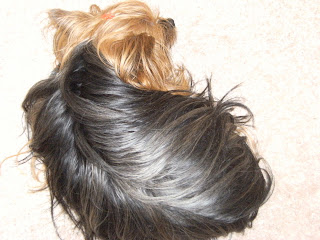

Ray and Beth Way Back When
If you've ever watched "The Simpsons" on TV then you know how poor Marge Simpson, thwarted at every turn as she tries to take care of her family and live her little life, GROWLS with frustration. I'm a nice person. Really. And, usually, I'm in a cheerful mood. BUT, if I am deprived of a deep-sleeping, blissful night of rest, I growl.

Silvie and Michelle in Earlier Days
Last night was a growly night. My 17-year-old poodle, Silvie, hasn't been well these past few days. She acts confused at times and is unsteady on her tiny feet. So anytime in the night that she struggles against me, trying to stand up, I wake up instantly. Usually, I pick her up and take her outside. I wait for her to come back in through the dog door, since I'm afraid she might wander around for a long time in the current very cold weather.

Silvie
She seemed better, but last night, she got up three times. The last time, I figured she didn't need to go out, but wanted some water, so I just put her on the floor beside the bed. I watched her go to the bathroom to get a drink and I dozed off . . . Until loud thumping feet woke me. The stupid cat, Hobbs, was bullying poor little Silvie, charging at her and knocking her around! Hobbs weighs 12 pounds - - Silvie weighs four. I yelled at the cat, got up, and rescued Silvie. Then tried to settle myself, Silvie, the other two dogs and the cat beside my husband, Ray.

Beth Napping with Maggie's Help While Michelle Watches
Deep in the "arms of Morpheus" I woke to hear Michelle, my other poodle, emit a soft cry. Then came five minutes of examining, soothing, and comforting 12-year-old Michelle, who hasn't seemed to feel well lately, either.

Michelle Resting After Rigorous Night
She didn't cry or do anything else, except look totally forlorn. Maybe she had a bad dream and just wanted to go back to sleep (like I did).

Morose Michelle
Back to deep hibernation . . . until Maggie, Holly's Yorkie, trilled from the floor beside the bed. HOBBS again! He wouldn't let Maggie get back onto the bed.

Maggie As A Christmas Fairy
This time Ray got up to rescue Maggie, but she screamed when he picked her up! Then she lay tight against me, not trembling or crying, but stiffly, as though in pain. Maggie has had pancreatitis and I began to fear that she was sick again. But little Maggie is a drama queen and maybe Hobbs had just scratched her.

Maggie
By the time I got up this morning (and thank God it was a snow day and I could sleep in!) I was feeling pretty tired, but all three dogs appeared fine and the cat was napping. I was tempted to push him off the printer.

Look How Innocent Hobbs Looks


Told You He Was Big
Now, waking up with sick family and pets is par for the mother course (so to speak) and I don't hold a grudge for lost dreams if someone is ill. But I have another problem when I try to "knit the raveled sleeve of care" as Shakespeare said. My husband is wild in bed.

My Handsome Husband
No, it's not what you think. Sleeping with my husband, Ray, is no picnic. In fact, some nights there is very little sleep for either of us.

Little Holly and Ray
Ray suffers from sleep walking. Actually, Ray sleep walks and I suffer from it. Scientists believe sleep walking is inherited and I believe it, since Ray's dad walked in his sleep, too. Family legend has it that Ray's dad once beat a bedside radio to smithereens while still sleeping. And Ray wonders why I sleep with a pillow between us.

Looks Harmless, Doesn't He?
Ray has gotten out of bed in the wee, small hours, dressed and tried to go to work, with me running beside him, trying to get through to him, like a Chihuahua yapping ineffectually at a Great Dane. Yet, all this time, he is sleeping.

Lydia, Ray, and Gizmo
I love my sleep. I hate to be awakened. Unless someone is sick or bleeding, I want to be left in dreamland all night long. Unfortunately, Ray's nocturnal ramblings are more frequent when he is sick and once resulted in quite a lot of bleeding.

Angie, April, and Ray
Not long ago, I was awakened by the familiar, agitated jouncing of the bed. As I grabbed Ray's wrist to wake him, he snatched his arm away from me and THREW himself out of bed. After a loud WHAM, I heard a terrible cry from Ray. I rushed around the bed to find him on the floor, bleeding from his mouth. He had dreamed he was high in a tree and was falling out. He landed with his face striking the round plastic bedside trash can. Part of the rim hit Ray's mouth, splitting his lip and causing the later loss of a tooth. The opposite rim of the can gouged Ray's throat, causing a lot of bleeding under the skin. He wouldn't go to the hospital right away, but eventually agreed when I showed him the way his lip gaped open when he talked. It made me a little dizzy and I'm not weak of stomach. The doctor at the hospital glued his lip back together and put a few steri-strips on it and it healed nicely.

Ray and Beth in Moscow
Over the years, Ray has awakened me repeatedly by getting up, turning on the lights and stripping all the covers off the bed. Did I mention that I don't like to wake up while I'm sleeping?
"Get up," he would say, "there's a snake in the bed." Or "Get up, there's an alligator in the bed."
"There's no snake (alligator, etc.) in the bed," I would insist, grabbing at the blankets and sheets. "You're sleepwalking; get back into bed!"
One night I was warm and cozy, probably dreaming of dating Clint Eastwood or something, when Ray sat up and said, "Is the reactor running?"
"Quick," I thought to myself, "which answer will satisfy Ray so he'll let me go back to sleep?"
Ray was field engineering a gasifier (also called a reactor) and had been working on it 24 - 7 for months. One of the problems he had with it concerned the ash screw, an auger that moved the wood ash out of the reactor. Surely he would prefer that the reactor be working?
"Yes," I answered, hoping I'd made the right call. "The reactor is working."
"Get out of the bed," Ray shouted, jumping up, starting to grab the sheets.
"All right." he exclaimed. "You'll be sorry when your toe gets caught in the ash screw!"
GROWL!!!!

Some Sleep All The Time
Thursday, December 30, 2010
HOLLY'S ELEPHANT EXPERIMENT


HOLLY'S SKETCHES OF THE ELEPHANTS

JEFF BOLLING, HOLLY, AND SUZI PEARSON POSE WITH TARA
I hope you have enjoyed the two previous elephant posts and photos. In 1998, eight years after my latest post, my daughter, Holly, did her school science experiment based on the question, "Do Elephants Really Never Forget?"

KELLY SITTING UP DURING A SHOW
It took a while and a little work, but Zoo Atlanta agreed to help Holly do her science experiment by brushing peanut butter on one tusking post (a large wooden slab) and roasted peanut oil (which smelled the same as peanut butter) on another tusking post. The peanut butter was always on the same post. The question was, will the elephants remember where the food was as opposed to where only the good smell was? Then Holly was allowed to observe twice weekly, and take notes and photos.

KEEPER SUZI PEARSON APPLIES PEANUT OIL TO TUSKING POST
The first time the posts were coated with the aromatic substances, the elephants were outside. As soon as they were brought into the barn, they began sniffing and searching for the delicious-smelling surprise. They visited the oiled post, snuffling and searching with their surprisingly adept trunk tips. Then they approached the tusking post with the peanut butter.

KEEPER SUZI PEARSON PUTS PEANUT BUTTER ON TUSKING POST

YUMMY PEANUT BUTTER!
As they quickly ran their trunks up the post, they began picking tiny bits of peanut better off and putting it into their mouths. It was only a matter of seconds before all three elephants were gathered around the post hurriedly grabbing any peanut butter they could find, each trying to get her share (or more!).

WHERE IS THAT WONDERFUL-SMELLING STUFF?

HOLLY TAKING NOTES OF ELEPHANTS' BEHAVIOR
The second time and all the times thereafter, the elephants rushed past the oiled post and converged on the post with bits of peanut butter. They definitely remembered!

KELLY ALLOWS LEAD KEEPER JEFF BOLLING TO EXAMINE HER MOUTH
We both enjoyed watching the elephants during this experiment. They had distinct personalities and were still young enough to be mischievous (they were about 15 years old). One day as we observed their behavior, one girl approached the big nylon garbage can used to hold their water. She put her trunk into the can and drank a little water. Then she grasped the top edge of the can and slowly and carefully laid it down on its side. Standing stock still, she watched the water flow out of the can and across the floor. After a few contemplative moments, she quickly jerked her head up, peered sharply around the barn, lifted the can upright, and hurried away to another part of the barn. Holly and I burst into laughter at the sheepishness of her retreat.

KELLY REACHES HIGH FOR THE BALL
Another day, as the elephants excitedly rushed to the tusking post containing peanut butter, they began shoving each other. It was a little scary, watching such big animals struggling, and I hoped our peanut butter wouldn't be the cause of a fight or injuries. A female keeper, looking tiny compared to the elephants, poked her head through the door into the barn, saying, "Hey! Hey! Hey!" The girls immediately stopped pushing and quietly searched for their treat.

KELLY BALANCES ON A LOG DURING SHOW
Soon I hope to visit Zoo Atlanta and get some photos with the elephants. Holly plans to go with me and we can judge how much they have grown, since she's about the same size as she was at 13. I wonder whether the girls will remember Holly? Is it true that "elephants never forget?"


JEFF BOLLING AND KELLY DURING AFTERNOON SHOW

KELLY'S PLEA FOR WILD ELEPHANT SURVIVAL
Tuesday, December 28, 2010
CHRISTMAS GIFT FROM MY OTHER LITTLE BUDDY

My friend in Almond, NC made this for me, after reading my post "My Little Buddy" about raising a chipmunk. It's painted on wood, with "sparklies" on the peppermints. Even the hairs are separate and the idea is so charming. Look at the cheek puffed with candy! Thank you, Mary DeHart!
Wednesday, December 8, 2010
ATLANTA'S AFRICAN ELEPHANTS

BFFs - Zambesi Affectionately Rests Her Trunk Under Victoria's Ear
I hope you enjoyed the story of the Asian elephants, Coca II and Twinkles, written in 1984. Now I'd like to continue the series with excerpts from an item on Atlanta's African elephants. When I wrote the Asian story, I was barely pregnant with my daughter Holly. When I "interviewed" the three African girls, Holly went along in her stroller and was attended by my niece, Angie, who also helped photograph the elephants. This article appeared in the summer 1990 issue of "Georgia Journal."

Starlet, Zambesi and Victoria Eating Hay
(Now Called Kelly, Dottie, and Tara - Their Original Names)
. . . . . Calves of only 7 and 8 years old, Starlet O'Hara, Victoria and Zambesi are much smaller than mature African elephants, which stand 8 to 13 feet high at the shoulder and measure more than 18 feet long.
The young ladies of Atlanta range from Victoria (6 feet 5 inches tall and 3700 pounds) to Starlet (6 feet 2 inches tall and a mere 3200 pounds).
Being the biggest, Victoria is probably the oldest," estimates Jim Black, Lead Keeper. The 10-year veteran (with three years at Zoo Atlanta) said elephants mature at age 18 to 20, "but adults continue to grow, although very slowly. They grow until their death." Being females, keepers expect these Southern belles to peak at 10 feet tall.

Starlet Catches A Stick With Her Trunk
Asked why all the elephants in Atlanta are cows, Black answered, "Partly because females in the wild live in families and herds. Males don't." In captivity, mature bulls can be "difficult and dangerous to work with and have killed people," according to Black.
Although Zoo Atlanta's three brown-eyed beauties are female and youngsters, Black and other keepers exercise great caution with them.

Starlet Holds Her Foot Up for Black To Inspect It
"Elephants are curious, destructive, incredibly strong. You have to watch them, Black said. "They see something; they think, 'Will it break? Can I eat it?'" In a zoo where Black formerly worked, an adult female elephant ate three wooden pallets. In fact, a curious elephant's theme song could be "Let's Get Physical."
Elephants are "physical" with each other, he said. Even very young females. "They thump each other with their trunks -- hard!" At that moment, Black cocked his head, listening. Going to a steel door leading into the barn, he smiled as he looked inside.
Starlet and Zambesi shuffled around quietly, making a slight snuffling sound. They pushed each other with their trunks, butted with their heads, whirled this way and that swiftly and easily. The "sparring" is play, but also helps determine the "pecking order" of the group. Victoria, "cock of the walk" because of her larger size, peacefully ate hay in the corner. As soon as the combatants heard Black's voice at the door, they hurried over to investigate. Starlet's trunk tip slithered through the slot in the door, trying to grab the visitor's hand. "Move back, Goof," Black said affectionately. The elephants immediately backed away from the door. Victoria resumed her dinner. Starlet and Zambesi began Round 10.

Starlet And Zambesi Sparring
Even though Starlet and Zambesi don't escalate from a sparring match to an angry fight, they do occasionally get into minor scrapes. "I have seen one adult knock another down. That's why we can't relate to them as a person, but as a dominant elephant."
To achieve dominance when he is so small compared to his charges, a keeper uses an ankus (Indian name) or elephant hook. This is a tool with a wooden handle about two feet long with a metal point and hook on one end. The point is blunt, the hook a little sharper. "It is like a leash for a dog or a bridle for a horse," Black said. It helps the keeper communicate with an animal of tremendous size and strength.

Jim Black Using Elephant Hook Or Ankus
"I can use it like an elephant uses its tusks, to prod. An elephant would pay no attention to my hand pushing or pulling against it. The tip of the elephant stick concentrates pressure. Used properly, it doesn't hurt. I'd like to emphasize that positive reinforcement (such as praise and treats), not fear and pain, are important in training. This is especially true in African elephants."
Asked why the zoo picked African elephants instead of Asians like the others the zoo had in the past, Black replied, "This section of the zoo has an African theme, so we have African elephants." In June, 1989, the new elephant habitat opened, which is "like a chunk of East Africa," modeled after Tsavo National Park in Kenya.

Starlet Shows Her Agility
After a rain, the Georgia red clay can be kneaded into a paste for a comfortable wallow. Elephants love their mud baths, but they adore swimming. The new habitat features a 65,000-gallon pond, which the elephants use constantly in warm weather. For now, the keepers bathe them every day and scrub them with Ivory Liquid every other day. The baths of water, sand and mud protect elephants' skin from sun and insects. Their skin, though an inch thick, is tender. This is something they have in common with their Asian cousins.

Starlet Performing At Zoo Atlanta
Black said Asian and African elephants could be kept in the same habitat; socially they are similar. But there are differences: The smaller Asians measure eight to 10 feet at the shoulder and weigh about five and one-half tons. Also, the larger ears of the Africans resemble the continent of Africa in shape. The Africans have two finger-like appendages at the tip of their trunks; the Asians have one. In the Africans, both males and females have tusks; only male Asians have them.
"Intellectually, Asians are quicker to manipulate objects and get with things faster," Black said. "They are equally trainable, but Africans are more high-strung and temperamental. They won't take as much pressure. You have to be more patient. Caring for elephants is a lot like raising kids.

Gary Roesinger Making Snack of Apples and "Vitamin Sandwiches" for Three Growing Girls

Roesinger Feeds A "Vitamin Sandwich" To A Willing Starlet While Black Watches and Victoria Waits Her Turn
"They run through the barn. They trumpet and throw their balls and tire and other toys when they are tired of being cooped up inside," Ms. Forrest said.

Note Starlet's "Africa-Shaped" Ears
Black added, "They always seem to get into mud before a show and when they flip 15- to 20-pound ears covered in mud, it really splatters in your face. They also seem to delight in tracking mud on the floor just as you finish mopping it." Still, some of their antics amuse rather than exasperate.
"Starlet acts goofy," Black said. "Sometimes when we feed them, she puts a large amount of hay on her head and just walks around looking ridiculous. And they're wild in mud and water. They will sit in the water on their haunches, like a dog, and splash around themselves in a complete circle with their trunks." They also like mud wrestling. "One will be rolling around in the mud and another will straddle it. They scream and thrash around, then the third one joins in and sits on the first one's head." Their play remains relatively gentle, however, for the three seem to truly care for each other.
Like first graders holding hands, Victoria and Zambesi stand close, with Zambesi's trunk nestled under Victoria's huge ear. When separated by a building which blocks the infrasound rumble (too low for humans to hear) with which they communicate 80 per-cent of the time, the "best friends" become frantic, Ms. Forrest said. They must be scolded and appeased with treats until they are in touch once more. Their dependence upon their keepers also manifests itself in touching ways.

Starlet Sitting Tall On A Drum
Although discipline might be viewed by the pachydermal eye as a poke with the prod, the elephants allow the pricks of blood tests and "shots" as long as comforting words, like "good girl" and "it's okay," are offered -- along with an apple afterwards. When training becomes confusing, an errant lass might "do something they know, something else to try to please us," Ms. Forrest said. This desire to please is apparent in the skills exhibited during the elephant shows staged thrice daily.

Starlet Stands On Two Feet
Starlet performed almost flawlessly on the unseasonably warm January afternoon of this interview. She bowed, stood on a drum on two feet, lay down, lifted her feet for inspection, held up her trunk, nodded, walked in a circle, and caught three sticks in her trunk as Black tossed them. Then she unfurled a sign reading "The End" before bowing to appreciative applause. Later, when I entered their barn for photographs, I appreciated even more Black's control over the three huge, rambunctious youngsters.

Coca II 1984

Twinkles With Head Keeper Ed Myers 1984
The three Africans were well behaved but, like toddlers, unpredictable. Compared with Twinkles, they were more active, more pushy about trying to investigate me. Twinkles stood quietly, just eying me and slowly edging closer. The terrific trio prowled around, surrounding me and closing in quickly. Standing there inhaling the fresh smell of hay, I felt like a bug with three curious lads crowding around with magnifying glasses in hand. However, they obeyed Black readily, wheeling away lightly on their tree-trunk legs when told to "back off." Meanwhile, I was curious about them, too.

Starlet Laying Down On The Job

Starlet Entertains Afternoon Crowds
Gary Roesinger, elephant keeper, told of Starlet's dismay and confusion after Coca's death. "She kept looking around, moving rapidly from place to place." The keeper shook his dark head sadly as he made sandwiches of bread pressed tightly around vitamin supplements. Black said, "They are grief-stricken when another elephant dies. To see a mother with a dead baby is heart-rending. She will stand by it for hours, trying to pick it up." He guessed Starlet, Victoria and Zambesi are the "left overs" of culls (the killing of whole herds of elephants when their numbers get too great).
These three were fortunate to have survived. While they must have suffered grief caused by the death of their families, together they have formed a new family. Intelligent, sensitive, social, flexible, the world's largest land animals continue to amaze and delight us.


Starlet Unfurls Sign Reading "The End"
Subscribe to:
Posts (Atom)